
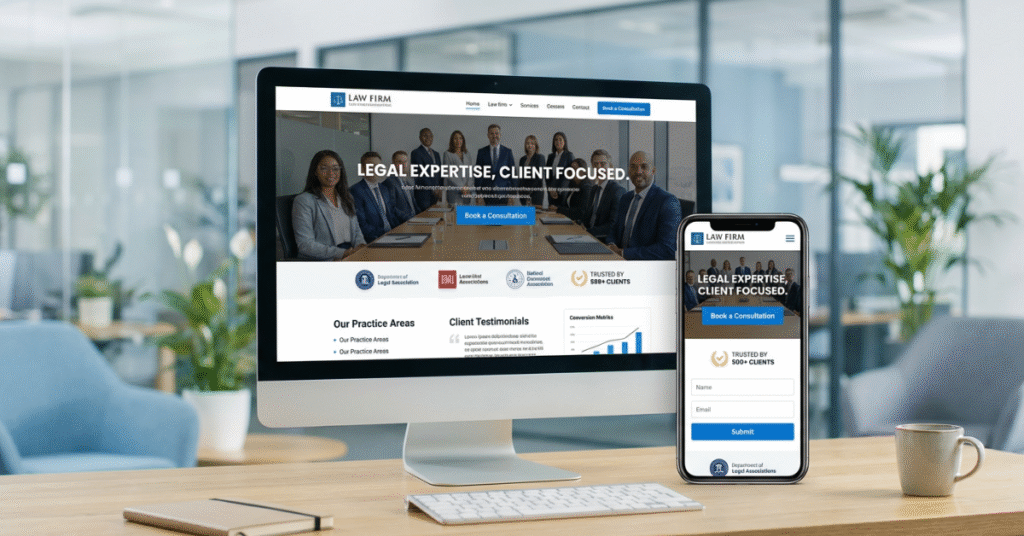
In an increasingly competitive legal market, having a website alone is no longer enough. Law firms invest heavily in SEO, Google Ads, social media, and directory listings, yet many struggle to convert visitors into real enquiries and clients. This is where law firm landing pages play a critical role. Unlike general website pages, landing pages are purpose-built to convert traffic into leads. When designed strategically, they help law firms generate more consultations, improve lead quality, and maximize the return on their marketing spend. Heading
Why Landing Pages Matter for Law Firms
A law firm landing page is not just another page on your website-it is a conversion-focused asset.
While homepages and service pages serve multiple audiences and objectives, law firm landing pages are designed with one clear goal: to prompt a visitor to take action.
Key Benefits of Landing Pages
- Reduce distractions and decision fatigue
- Align precisely with user intent
- Address a specific legal problem
- Guide visitors toward a single conversion action
Common Use Cases
Law firms typically use landing pages for:
- Pay-per-click (PPC) advertising campaigns
- SEO-driven practice area pages
- Social media campaigns
- Email marketing funnels
- Location-specific or niche legal services
Sending targeted traffic to a focused landing page for law firm significantly increases the likelihood of conversion.
What Is a Law Firm Landing Page?
A law firm landing page is a standalone web page designed to achieve a single, clearly defined conversion goal.
Typical Conversion Goals
- Booking a free or paid consultation
- Submitting a contact or enquiry form
- Downloading a legal guide or checklist
- Calling the law firm directly
How Landing Pages Differ From Other Pages
Unlike homepages or service pages, landing pages:
- Have minimal or no navigation
- Focus on one specific service or audience
- Contain a single primary call-to-action
- Are built to convert, not just inform
This focused structure removes friction and helps visitors make faster decisions.
Landing Page Goals & Use Cases
Generate Consultation Leads
The most common objective for law firm landing pages is consultation booking. These pages encourage visitors to:
- Schedule a free consultation
- Request a paid legal review
- Ask for a callback
Clear messaging and short forms work best for this purpose.
Capture Qualified Leads Using Lead Magnets
Some law firms prefer to nurture prospects before direct contact. In such cases, landing pages may offer:
- Legal checklists
- Rights and compliance guides
- Case preparation resources
These resources are exchanged for contact information, helping firms build long-term pipelines.
Convert Services or Fixed-Fee Offerings
Law Firms offering fixed-fee services or online consultations can use landing pages to drive direct service conversions.
Core Elements of a High-Converting Law Firm Landing Pages
1. Clear and Compelling Headline
The headline is the first thing visitors see and must instantly communicate relevance.
A strong headline:
- Clearly states the legal service offered
- Matches the visitor’s search intent or ad copy
- Includes location or urgency when appropriate
The goal is to reassure visitors that they are in the right place.
2. Persuasive Sub-Headline
The sub-headline supports the main message by explaining the benefit or outcome.
It should reinforce trust, expertise, or the unique value of your firm in one concise sentence.
3. Value-Driven, Client-Focused Content
High-converting landing pages speak to the client’s problem, not the firm’s credentials alone.
Effective content:
- Uses simple, non-technical language
- Focuses on benefits rather than features
- Addresses common client concerns
Anticipate and answer questions such as:
- How long will the process take?
- What are the costs involved?
- What happens after I contact the firm?
4. Strong Value Proposition
Your value proposition explains why a visitor should choose your firm over competitors.
This may include:
- Specialized experience
- Proven results
- Transparent pricing
- Fast response times
- Clear legal process
Specific, outcome-oriented statements build confidence and trust.
5. Intuitive Design and Layout
Design has a direct impact on conversions.
A high-performing landing page:
- Guides the eye from headline to proof to call-to-action
- Uses clear headings and white space
- Breaks content into scannable sections
- Is fully optimized for mobile devices
Good design improves clarity, usability, and credibility.
6. Trust Signals and Social Proof
Legal decisions involve high levels of trust. Reinforce credibility using:
- Client testimonials
- Online reviews or ratings
- Case outcomes (where permitted)
- Professional memberships or certifications
- Awards or recognitions
Even minimal social proof can significantly increase conversions.
7. Lead Capture Form
Forms should be easy and quick to complete.
Best practices include:
- Asking only essential information
- Using clear labels and instructions
- Explaining what happens after submission
- Including a brief privacy assurance
Shorter forms typically result in higher completion rates.
8. Clear, Action-Oriented Calls to Action
Your call-to-action (CTA) should clearly state what the visitor will receive.
Effective CTAs focus on benefits, such as:
- “Get a Free Consultation”
- “Speak to a Lawyer Today”
- “Request Legal Advice Now”
CTAs should be placed strategically throughout the page.
9. SEO and Mobile Optimization
A landing page must be both discoverable and user-friendly.
Ensure the page includes:
- Optimized title tags and meta descriptions
- Proper heading structure
- Fast loading speeds
- Responsive mobile design
Mobile users often show high intent, making optimization essential.
Messaging and Search Intent Alignment
Landing pages for Law firm content must align closely with how users search and why they click.
This means:
- Matching headline language to keywords and ads
- Addressing specific legal problems
- Including location-based relevance where applicable
When messaging matches intent, visitors are more likely to stay and convert.
Building Trust and Credibility
Client Testimonials and Reviews
Short, authentic testimonials with names or initials build confidence.
Case Results and Proof
Share outcomes responsibly while maintaining confidentiality and ethical standards.
Professional Affiliations and Awards
Logos of bar associations, certifications, and recognitions enhance legitimacy.
Lead Capture and Form Best Practices
To improve conversion rates:
- Keep forms short
- Display privacy and consent notices
- Offer multiple contact options such as phone, form, or chat
Providing choice increases user comfort and trust.
Optimization and A/B Testing
Landing pages should be continuously improved using data.
Track key metrics such as:
- Conversion rate
- Bounce rate
- Time on page
Test variations of:
- Headlines
- CTA text and placement
- Form length and structure
Regular testing leads to consistent performance gains.
Common Mistakes to Avoid
Avoid these common pitfalls when creating law firm landing pages:
- Overloading pages with text
- Using excessive legal jargon
- Including multiple competing CTAs
- Neglecting mobile optimization
- Sending traffic to unfocused pages
Each mistake reduces conversion potential.
Conclusion
A well-designed law firm landing pages is one of the most powerful tools for client acquisition.
By focusing on clear messaging, trust-building elements, and a single conversion goal, law firms can use landing pages to transform website visitors into qualified leads and long-term clients.
Landing pages are not just marketing pages-they are strategic growth assets for modern law practices.
This article is part of Law Firm Websites & Conversion – our in-depth pillar guide covering the full topic for Indian lawyers.
Read the full guide →